
Unofficial · Built for Penn State students
Your degree is a route map.
Now you can see it.
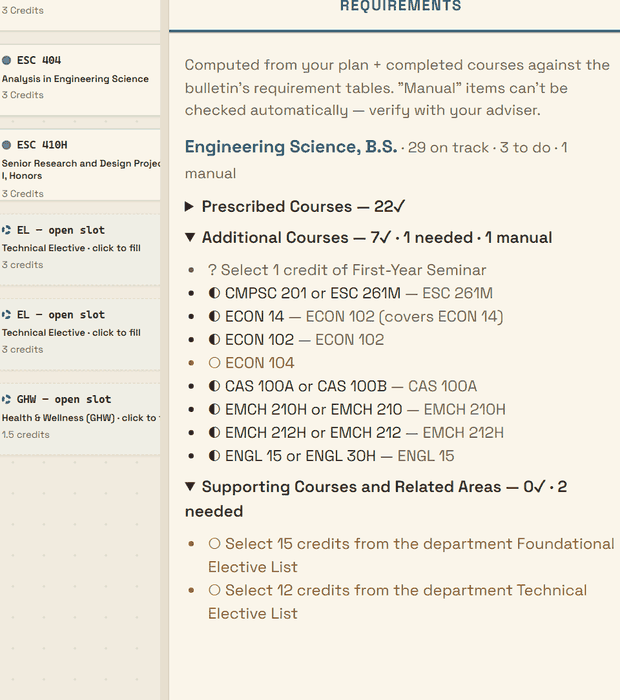
LionsDegree reads Penn State's Bulletin, works out what unlocks what, and builds a four-year plan that actually holds. Drag a course and it tells you what breaks.
Open the planner Watch it work
Free and open source. No account needed to try it.
Unofficial. Not affiliated with or endorsed by Penn State.
14,615 courses read
759 programs
95% of requirements machine-verified
The data is real
Straight from the Bulletin
Prerequisites are parsed from Penn State's own text rather than hand-entered, and every course links back to the page it came from. If something cannot be verified, it says so.
One real chain
Thirteen courses, and the one that does not fit.
It solves the ordering
Fewest terms, nothing out of sequence
The optimizer balances your credit load, keeps the prescribed core early, and never schedules a course before the thing it depends on. Capstones land at the end, where they belong.
It works on your phone
Built for registration week
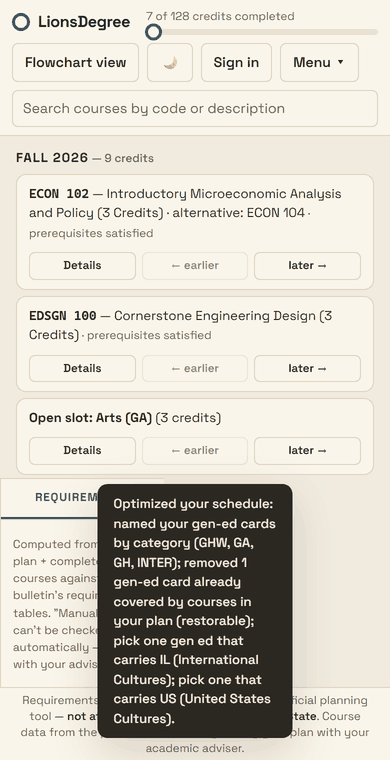
The list view carries everything the chart does — every course, every prerequisite status, every action — for when you are on a phone at 7am fighting for a seat.
The part nobody else does
Describe what you are into. Get a combination of real credentials.
“machine learning and clean energy”
- Artificial Intelligence Methods and Applications, B.S.major
- Energy Business and Finance, Minorminor
- Building Artificial Intelligence, Certificatecertificate
9 credits count twice · a real result from the 2026-2027 bulletin
Paste this to your assistant:
Swap in your own interests. Works in Claude, ChatGPT or whatever you use once it is connected — here is how to connect yours.
Works with your assistant
Bring your own AI.
Connect LionsDegree to Claude, ChatGPT or whatever you already use. Your assistant reads your actual plan and answers questions about your degree instead of guessing at it.
- “What do I still need for my major?”
- “Can I take CMPSC 465 next spring?”
- “I want to study abroad in fall 2027 — rearrange my plan.”
Try it yourself
A few real courses, right here.
Drag one somewhere its prerequisite does not allow and watch the engine catch it — without signing up for anything.
In development The planner already does this. Open it and drag a course into a term it does not belong in.
What this isn't
The things it will not pretend to know.
Not affiliated with or endorsed by Penn State.
Not a substitute for your adviser. Confirm before you register.
It cannot see when a class actually runs — Penn State does not publish that in a form anyone can read automatically. Check LionPATH.
If a requirement cannot be verified, it says so instead of guessing.
95% of requirements across 759 programs resolve to real, named courses.
Measured against the 2026-2027 bulletin, not estimated. 14,458 requirements name their courses outright, and 277 give you a subject and a level to choose within. 691 we could not read at all, and those are flagged for you rather than guessed at. 39 are General Education buckets, filled from the designations a course carries.
Left out of that percentage altogether: the 975 requirements where the Bulletin publishes no list and tells you to ask your adviser. Those are not failures to read something — there is nothing there to read — so the planner shows you the requirement's own wording instead.
About
Built by a student who got tired of the spreadsheet.
Planning a Penn State degree means holding four documents open at once: the Bulletin for what your major requires, a page per course for what it needs first, the General Education framework, and LionPATH for what you have already done. Nothing joins them up. So everyone builds the same spreadsheet, and everyone's is slightly wrong.
It is one person's side project, not a company — started in September 2026 and open source under Apache 2.0, so you can read exactly how every number on this page was produced.
The rule it is built on: never guess. Course data comes from a deterministic parse of the Bulletin's own markup, no language model ever writes into the catalog, and anything the parser cannot read is shown to you as unreadable rather than filled in with something plausible.
Contact
Tell us what is wrong.
Found a requirement it read incorrectly, a prerequisite it missed, or a course that should not be there? Every catalog bug reported is one no other student hits.
Or email [email protected] directly. Bugs in the planner itself are best filed as GitHub issues.